
Daechwita
bNKXxwOQYB8
페이지 정보
작성자 작성일 24-04-07 18:03본문
The name BTS (방탄소년단) has, over the last few years, essentially become a household name not just in Korea, but in countries all over the world. As Hallyu (한류), or the Korean Wave, continues to gain momentum, Korean culture and history has begun to spread to all corners of the world not just within the classroom, but in individuals’ homes as individuals take in diverse forms of content that show the Republic of Korea and its culture in all its beauty and richness.
One music group that is taking a lead role in this spread of cultural awareness is BTS. The seven-member group, through their music, stage performances, music videos, and interviews, have used their popularity to draw attention to their Korean heritage, not shying away from displaying the pride they hold in their country and their culture. From wearing modern hanbok in a stage performance on the American late night talk show The Tonight Show Starring Jimmy Fallon, to incorporating an entire traditional performance that included samulnori (사물놀이), a traditional fan dance (부채춤), a traditional mask dance (탈춤), and bukchum (북춤), a dance that is performed while playing the drums, BTS has never backed down from the chance to display traditional Korean culture. Within just a seven-minute stage performance, BTS managed to display a plethora of traditional Korean music styles and performances that would be viewed by fans all around the world.
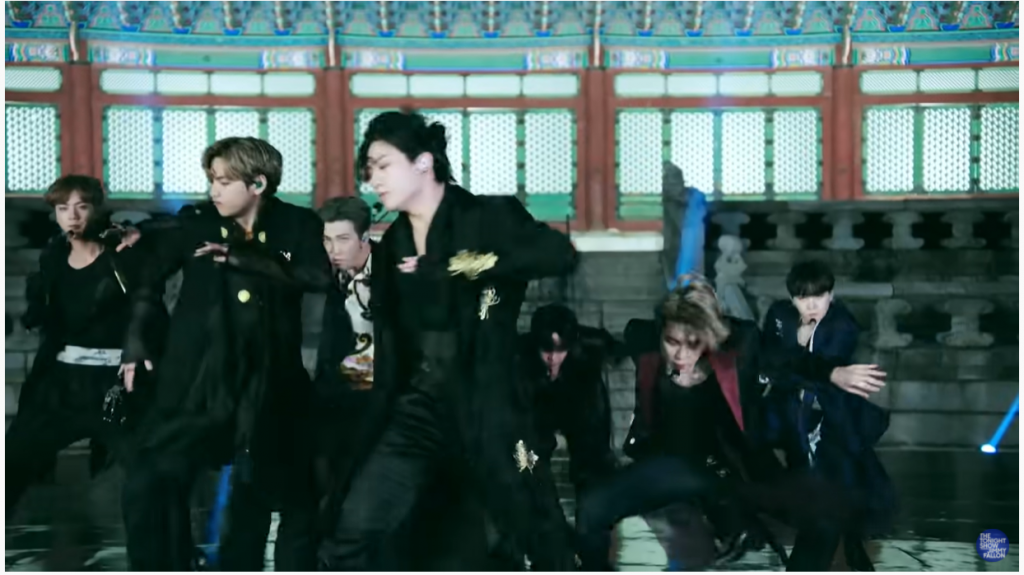
BTS performing their hit song “Idol” on The Tonight Show Starring Jimmy Fallon in front of Gyeongbokgung Palace while donning modern hanbok
Adding yet another dimension to this incorporation of Korean history and culture, both modern and traditional, to modern-day music performances, BTS member Suga, under the second pseudonym Agust D, released a song and corresponding music video titled “Daechwita” as part of his 2020 solo project mixtape. The song is one-hundred percent rap and hip-hop, with fast-paced lyrics layered atop a trap beat that exude a fiery and almost aggressive energy. But below all of the modern elements, the sounds of traditional Korean instruments is unmistakable, with the ringing of a gong sounding out every eight count combined with the blares of a traditional oboe-like wind instrument constructing a solid backbone for the entire song.
The song itself is one thing worth analyzing, but there are also the carefully placed details in the music video that are more than worth delving into. From the backdrop to the clothing, there are centuries of Korean history portrayed in just under five minutes that deserve in-depth explanations in order to be truly appreciated.
Even if you have never heard “Daechwita,” the following information and explanation may be of great interest to you, especially if you wish to learn just a bit more about Korean history or traditional Korean music.
Daechwita (대취타)
Daechwita (대취타, 大吹打) is a style of military music that was performed during the Joseon Dynasty (1392 – 1910). The word daechwita is constructed of the roots de- (대), meaning “large”, and chwita (취타), meaning “wind and percussion instruments.” Therefore, daechwita is a musical performance that utilizes both wind and percussion instruments and is made up of a vast number of performers. Daechwita falls under the larger musical category of chwita (취타), or military music, which can then be divided into daechwita and sochwita (소취타), the latter being a smaller scale version of daechwita that contains less genres of instruments and is performed for different occasions.
Daechwita was mainly performed when the main gate to the camp the military used was opened and closed, when the military would march out or come back to the palace victorious from whatever battle or conflict arose, and when the king would leave the palace on official business. While the monarchy of the Joseon Dynasty as well as the military from that time are no longer present, daechwita is still performed today, and has been played when leaders of foreign countries have arrived in the Republic of Korea.

A performance of daechwita in Changdeokgung Palace, 2006
During the Joseon Dynasty, the number of people who constituted one performance group could reach up to nearly five hundred, truly living up to the name daechwita. Nowadays, most performance groups consist of only around fifty people at most.
The list of instruments used is rather extensive and has naturally changed with the passing of time.The modern performances of daechwita utilize the following instruments:

The wind instruments used in modern-day performances of daechwita (nagak, nabal, taepyeongso)
Wind instruments:
- nagak (나각) – a seashell horn
- nabal (나발) – a long metal trumpet
- taepyeongso (태평소) – a conical oboe with a wooden body and a metal bell

Three of the main percussion instruments played in daechwita (jing, yongo, jabara)
Percussion Instruments:
- jing (징) – a large gong
- jangu (장구) – a double-headed hourglass-shaped drum
- buk (북) – a barrel drum that is more commonly seen in performances of pansori (판소리) and samulnori (사물놀이)
- jabara (자바라) – a pair of large brass cymbals
- yongo (용고) – a barrel drum with a dragon painted on its shell
Amongst these instruments, the taepyeongso is the only instrument that is able to change pitch, and thus creates the melody within daechwita. Opposite of that, the nagak and nabal can only produce one pitch, and thus act as the backbone for the performance, playing long and drawn out low tones that contrast sharply against the high pitched taepyeongso.
The slow and regal sound of daechwita can be heard in the very beginning of Agust D’s song. The drawn out tones of the nabal and nagak, the high-pitched cries of the taepyeongso, and the steady beating of the yongo, buk, and jangu create a chilling introduction that quickly moves on to blend in with a more modern beat. On top of all of this is a man’s voice, shouting the phrase “Hit the gong once and then begin daechwita!” (명금일하대취타 하랍신다), appropriately followed by the striking sound of the jing. This is an accurate representation of a very crucial part in the daechwita performance, where the leader of the group declares the beginning of the performance by shouting this phrase. A similar action is done to signal the end of the performance, with the leader shouting “Stop the music!” (헌화금 / 허라금) and drawing the performance to a close. In Agust D’s “Daechwita,” the signal to stop the music is never given, and thus the song ends on a rather unfinished note, almost sounding as though it is being cut off right in the middle.
While the song itself is entitled “Daechwita,” aside from the introduction, there is very little within the main body of the song that resembles the traditional sound of daechwita. The most notable difference is the use of instruments that are not performed in daechwita. Specifically, after the jing is struck to signal the beginning of the song, the sounds of the ggwaengwari (꽹과리), a small brass gong, as well as a the fast pluckings of a harp-like instrument are suddenly introduced along with a dramatic change in tempo to something that is much faster than anything one would hear in a traditional daechwita performance. However, the ringing of the jing and the rather sporadic melody of the taepyeongso are maintained throughout the song and, even though they are being played outside of their usual context, they serve as a reminder to listeners about the traditional sounds of daechwita.


